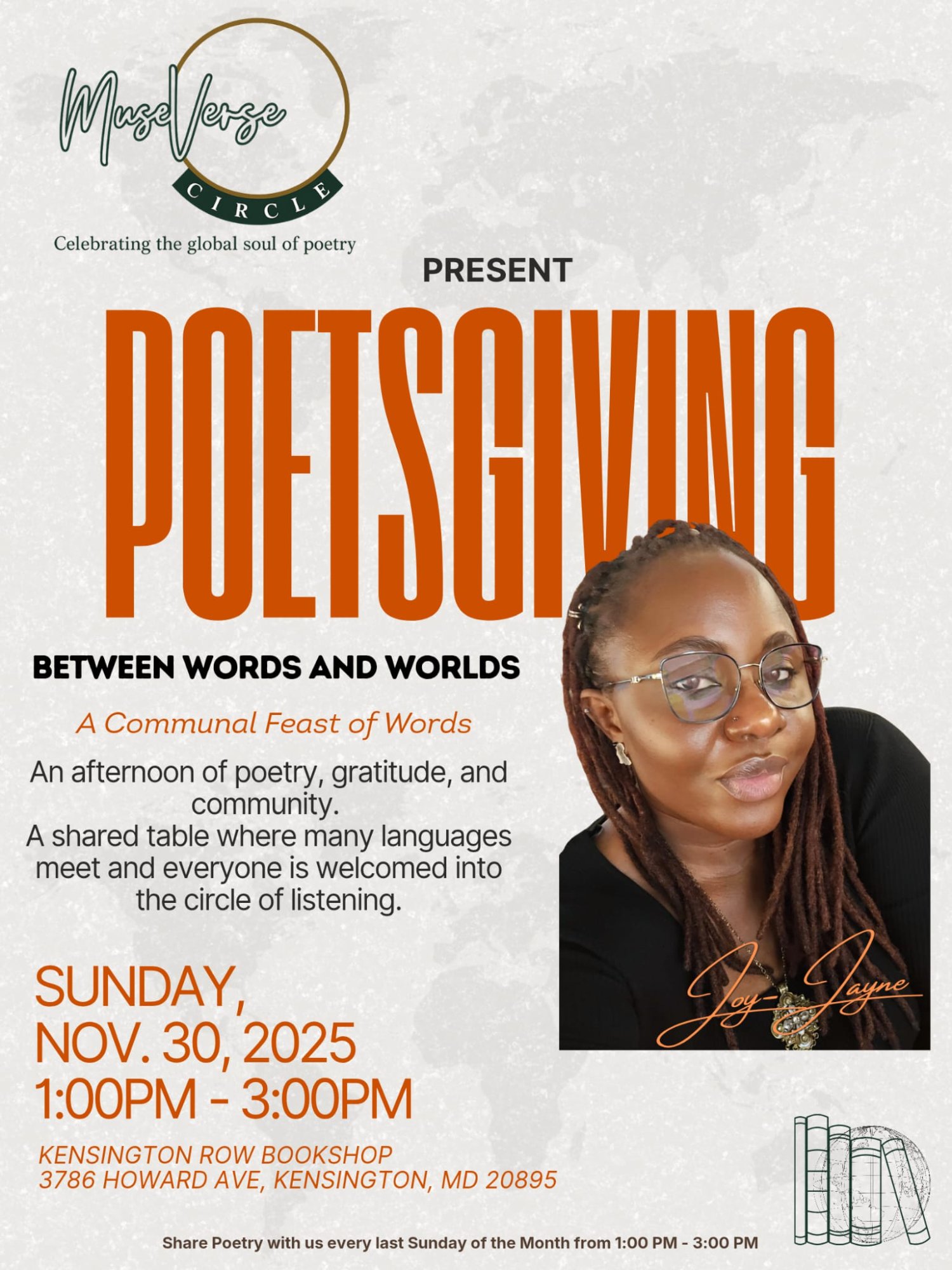
Poetsgiving:
A Communal
Feast of Words
The circle held. The year passed. The work continues.
The last gathering of the year is always the most tender.
November 30 fell at the edge of things. The week of Thanksgiving, when roads fill and families reconvene, when the world turns inward toward its own hearths and tables. Most people were on their way somewhere else. And still, some came. Some stayed where they were and joined from a distance. Some chose poetry over the traffic, the noise, the holiday season's relentless pull toward consumption and performance.
Poetsgiving was Joy-Jayne's answer to that season. A different kind of feast. A table set with seven poems instead of seven dishes. An afternoon of gratitude that required nothing except a willingness to sit with language that had been written to survive difficulty and arrive with something true still intact.
The word Thanksgiving carries within it an act of recognition. To give thanks is to name what has sustained you. These seven poems do exactly that. Naomi Shihab Nye tells you kindness finds you after sorrow and goes with you everywhere. Ada Limon watches the trees return after winter and decides to take it all. Lucille Clifton asks you to celebrate what she has made of a kind of life with no model and every reason not to. Derek Walcott tells you the time will come when you greet yourself arriving. Mary Oliver tells you you only have to let the soft animal of your body love what it loves.
Joy-Jayne held the table alone and the room was full. This is what founders do. They show up for the work even when it is quiet, even when the holiday season has taken everyone somewhere else. The circle was smaller that afternoon. It was complete.
Every poem chosen for this gathering asks the same question: what does it mean to come home to yourself? Seven voices. Seven traditions. One table. One invitation to return.
A year of gatherings, held and given. A table set with words.
Kensington Row · November 30, 2025The founder of MuseVerse Circle hosted the year’s closing gathering alone for the first time. She chose seven poems and built the evening around the oldest human gesture: gathering together at the end of something to say thank you. The room held her the way the circle always holds its host. With attention. With generosity. With the willingness to receive whatever arrives.

MuseVerse Circle closes its first year with gratitude. Six gatherings. Five language traditions. Two homes. Every voice that entered this circle changed it.
A poem about what kindness requires of us, and what it costs.
Before you learn the tender gravity of kindness, you must travel where the Indian in a white poncho lies dead by the side of the road.
Read the full poemA meditation on return, on what persists, on the way the natural world refuses to give up even when we have.
More than the fuchsia funnels breaking out of the crabapple tree, more than the neighbor’s almost obscene display of cherry blooms.
Read the full poemA survival anthem, a declaration, a prayer. It was written to be shared. It was written for rooms like this one.
Come celebrate with me that everyday something has tried to kill me and has failed.
Read the full poemPoems that sit with you in the dark and do not pretend the dark is not there.
You have to say hello to the things you did not choose. The shape of your face. The country of your birth.
Read the full poemAbout love that protects without diminishing, about the strange courage of being cared for.
Love, at its most precise, is an act of reading the weather and arriving with exactly what is needed.
Read the full poemA poem about homecoming. About the return to oneself after years of looking for belonging in other people’s eyes.
Give wine. Give bread. Give back your heart to itself, to the stranger who has loved you all your life.
Read the full poemThe poem that ends evenings like this one because it gives permission. You do not have to be good.
You do not have to be good. You do not have to walk on your knees for a hundred miles through the desert, repenting.
Read the full poemAll poems featured in MuseVerse Circle gatherings are sourced from the public domain, authorized educational translations, or used with the express permission of the poet or their estate.
The threads that ran through every poem.
Wild Geese, Love After Love, and Lucille Clifton’s anthem all offer the same essential gift: permission. To be imperfect. To return to yourself. To survive and not apologize for it.
Kindness does not arrive without cost. The Facts of Life does not pretend that acceptance is easy. These poems earn their gratitude.
Poetsgiving was a gathering in the oldest sense. A community choosing to mark its survival together. To say: we were here. We held something together this year.
What stayed with those who listened.
I came not knowing what Poetsgiving was. I left knowing I had been part of something.
Attendee reflection · November 30, 2025Lucille Clifton’s poem should be read at the beginning of every year and the end.
Attendee reflection · November 30, 2025Wild Geese felt like permission I have been waiting for without knowing it.
Attendee reflection · November 30, 2025The circle held. That is the sentence I keep coming back to.
Attendee reflection · November 30, 2025Those who made this possible.
Every poem that enters this room has traveled a long road to get here. It passed through the hands of translators who gave years of their lives to carrying meaning across languages without losing the soul of what was said. Through archivists who preserved what time and politics tried to erase. Through scholars and historians who gave context to what might otherwise arrive without roots.
MuseVerse Circle stands on all of that work. We are grateful to every person who has ever built a bridge between a poem and a reader who needed it.
This gathering is dedicated to the translators, the archivists, the educators, the historians, the curators, and the poets themselves. The people who keep language alive so the rest of us can find our way home in it.
The reading guide for this gathering.
Poet portraits, historical context, thematic threads, discussion prompts, and Joy-Jayne’s curatorial notes. Freely available to all.
Read the guide